




SHRM & HRCI Approved Webinar | CEUs = 1.5 Credit Hours
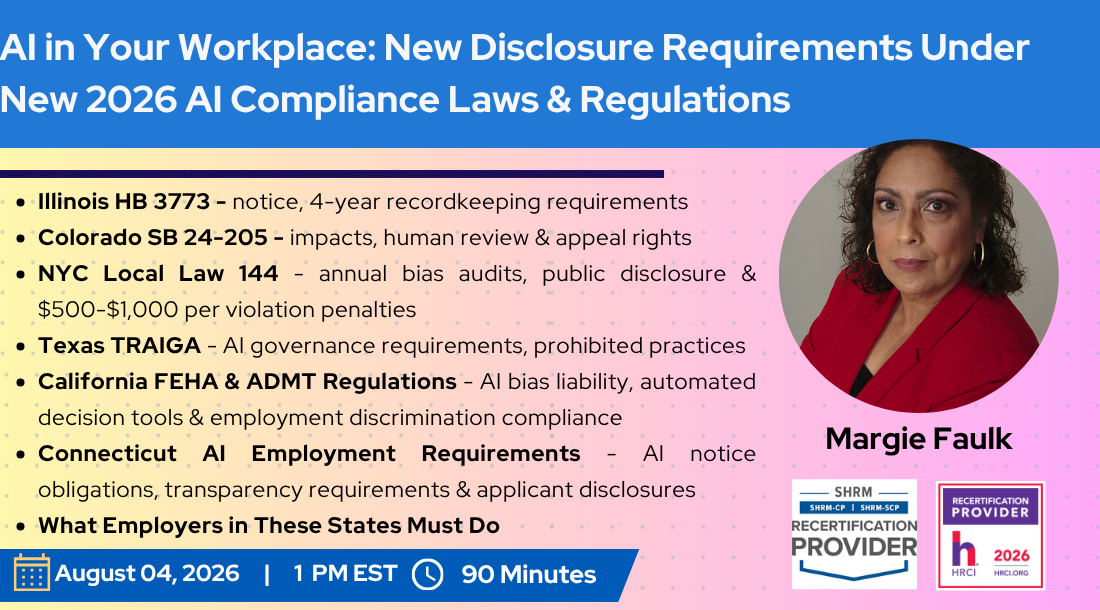
"Navigating AI Compliance in Employment Decisions: Key Requirements Under Illinois HB 3773, California FEHA/ADMT Rules, Colorado SB 24-205, Texas TRAIGA, NYC Local Law 144, and Emerging State AI Laws"
Overview:
Artificial intelligence is now embedded in nearly every stage of the employment lifecycle — from resume screening and video interview analysis to performance management, scheduling, and termination decisions. And in 2026, the legal framework governing how employers use AI in employment decisions has changed dramatically.
A new wave of AI regulation is already here. Illinois HB 3773 became effective January 1, 2026, Colorado's AI Act (SB 24-205) takes effect June 30, 2026, Texas's TRAIGA is now in force, and New York City's Local Law 144 continues to impose strict bias-audit and disclosure requirements. If AI influences your hiring, promotion, performance management, or termination decisions, your organization could face compliance obligations you may not even realize exist. Join us to learn what these laws require, where employers are most vulnerable, and how to address AI-related risks before they become enforcement actions.
What will You Learn:
- Illinois HB 3773 - effective January 1, 2026 - notice, anti-discrimination & 4-year recordkeeping requirements
- Colorado SB 24-205 - effective June 30, 2026 - impact assessments, human review & appeal rights
- NYC Local Law 144 - annual bias audits, public disclosure & $500-$1,000 per violation penalties
- Texas TRAIGA - AI governance requirements, prohibited practices & enforcement considerations
- California FEHA & ADMT Regulations - AI bias liability, automated decision tools & employment discrimination compliance
- Connecticut AI Employment Requirements - AI notice obligations, transparency requirements & employee/applicant disclosures
- What Employers in These States Must Do
- Emerging State AI Laws - developing requirements in Utah and other jurisdictions shaping future employer obligations
- AI Inventory & Risk Assessments
- How to Identify every AI tool in your employment process and assess disclosure, bias audit & compliance exposure
- Testing for Algorithmic Discrimination & Documenting Mitigation
- Building Your 2026 AI Compliance Action Plan
Why You should Attend:
Employers using AI in hiring, performance management, or termination decisions are already subject to disclosure and anti-discrimination obligations in multiple jurisdictions — and most do not know it. Here is why every employer must attend.
For multi-state employers, the compliance challenge is significant: different disclosure formats, different audit requirements, different enforcement mechanisms, and different definitions of what counts as "AI" or an "automated employment decision." Meanwhile, Federal Bipartisan Bills in both the Senate and House would impose human oversight and disclosure requirements for AI used in employment decisions at the national level. Employers who are using AI tools today - even off-the-shelf HR software with embedded AI features - without understanding their disclosure obligations are already out of compliance in at least three jurisdictions and accumulating penalties. The time to act is now.
Who should Attend:
- All Employers
- Business Owners
- Company Leadership
- Compliance professionals
- Payroll Administrators
- HR Professionals

Continuing Education Accreditations
SHRM -
CEU Services is recognized by SHRM to offer Professional Development Credits (PDCs) for the SHRM-CPSM or SHRM-SCPSM. This program is valid for 1.5 PDCs for the SHRM-CPSM or SHRM-SCPSM. For more information about certification or recertification, please visit - portal.shrm.org.
HRCI -
This webinar has been approved for 1.5 HR (General) re-certification credit hours toward California, GPHR, HRBP, HRMP, PHR, and SPHR recertification through the HR Certification Institute.
The use of this seal is not an endorsement by the HR Certification Institute of the quality of the activity. It means that this activity has met the HR Certification Institute’s criteria to be pre-approved for re-certification credit.