
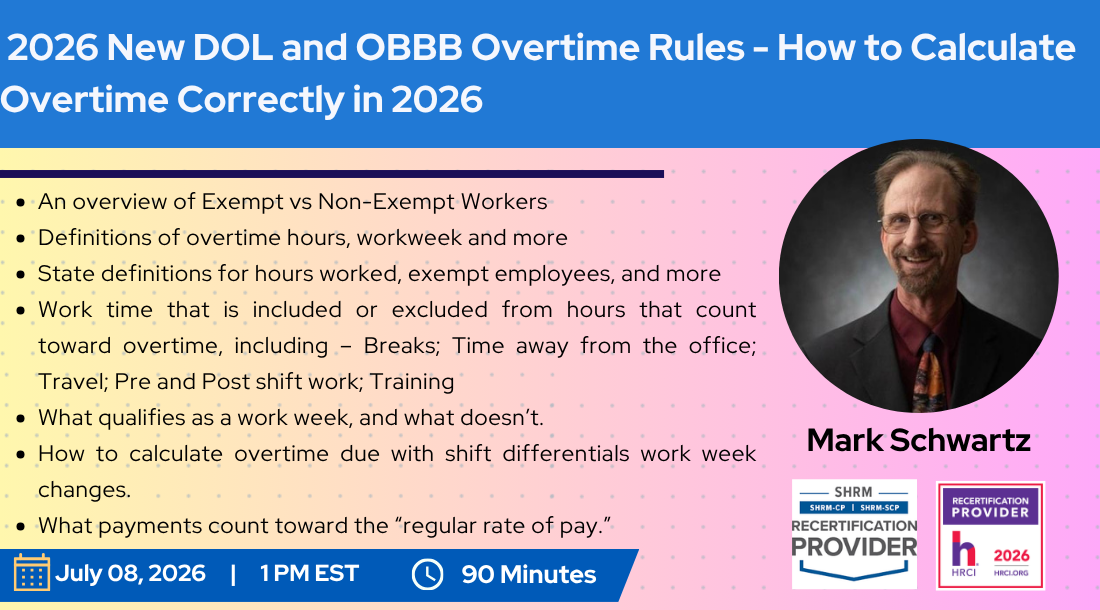




HRCI & SHRM Approved Webinar | CEUs = 1.5 Credit Hours
Overview:
THE DOL issued its new Final Rule on Exempt Workers. The Rule increases salary thresholds for all employees who can be considered exempt from overtime. Learn exactly what the new amounts are and other information from the rule.
The OBBB of 2025 enforces a “no tax on overtime” rule through 2028. Learn how this affects payroll obligations. Do you know all types of payments that carry an overtime premium? If not, Join Mark Schwartz in this informative webinar designed for the seasoned payroll professional to properly analyze compliance with overtime regulation, and help their CFO properly budget payroll expenses. You will also find the answers to the following questions, and more:
- What hours worked qualify for paid wages, and which don’t? Which qualify for overtime premiums, and which don’t.
- What fringe benefits and supplemental payments should be counted toward the hourly rate of pay?
- Are there any restrictions on setting work weeks?
- What does the OBBB mean for payroll deductions and reporting?
- How do you account for shift differentials, when an employee’s workweek changes, etc?
- Do payments made after a regular pay day need to be applied to weeks wherein overtime was worked?
- What states have overtime rules that are different than the minimums set by the Fair Labor Standards Act.
- What the Texas Federal Court’s overturning of the salary requirements means for employers who updated them in 2024.
What will You Learn:
In this 90minute webinar, you will learn the following about calculating overtime accurately:
- The basics of overtime as established in the FLSA, including:
- An overview of Exempt vs Non-Exempt Workers
- Definitions of overtime hours, workweek and more
- Employers NOT covered by the FLSA
- The OBBB “no tax on overtime” rules
- State definitions for hours worked, exempt employees, and more
- Work time that is included or excluded from hours that count toward overtime, including – Breaks; Time away from the office; Travel; Pre and Post shift work; Training
- What qualifies as a work week, and what doesn’t.
- How to calculate overtime due with shift differentials work week changes.
- What payments count toward the “regular rate of pay.”
- How to calculate regular rate of pay in unusual circumstances
- How to take into account pay that happens outside the normal payday for weeks worked overtime.
- And much more, including NUMERICAL EXAMPLES.
Why You should Attend:
Although the rules on exempt vs non-exempt employees have changed a few times in the past 10 years, overtime worked is, and has always been, overtime earned. THERE ARE NO EXCEPTIONS. But 1.5 time a worker’s hourly rate of pay is just the start of calculating overtime earned. This course is designed as a refresher on what hours and payments are considered in calculating overtime pay.
Who should Attend:
- Budgeting personnel
- Payroll personnels
- Management
- HR managers
- Department managers
- Budget personnel
- Timekeepers
- Financial Dept. Personnel

Continuing Education Accreditations
SHRM -
CEU Services is recognized by SHRM to offer Professional Development Credits (PDCs) for the SHRM-CPSM or SHRM-SCPSM. This program is valid for 1.5 PDCs for the SHRM-CPSM or SHRM-SCPSM. For more information about certification or recertification, please visit - portal.shrm.org.
HRCI -
This webinar has been approved for 1.5 HR (General) re-certification credit hours toward California, GPHR, HRBP, HRMP, PHR, and SPHR recertification through the HR Certification Institute.
The use of this seal is not an endorsement by the HR Certification Institute of the quality of the activity. It means that this activity has met the HR Certification Institute’s criteria to be pre-approved for re-certification credit.